Recollecting Burt’s time in the rehab center today gave me a little relief although the memory was hard. The fact that I could affirm that I stood for him when he needed my protection felt good.
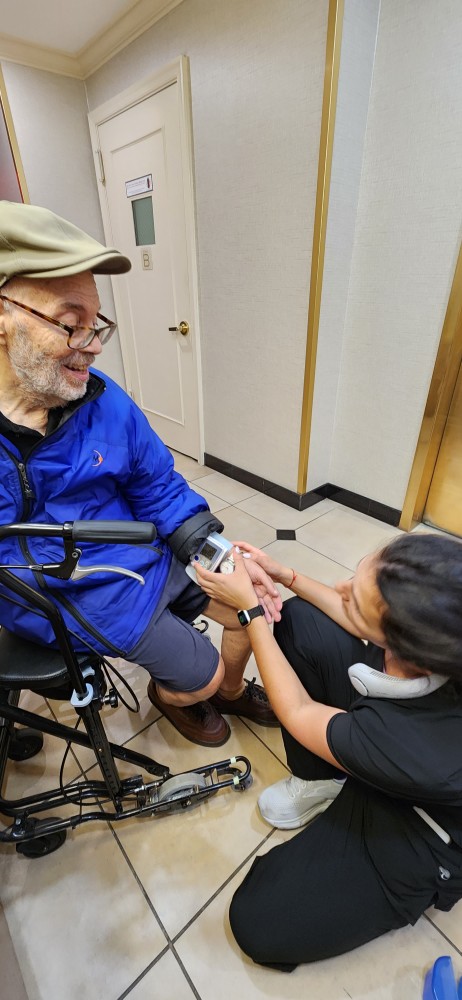
The nursing home-rehab was not a good place. I would not have placed Burt there over the long haul. I did choose to keep him in the facility longer than Medicare allowed because he needed the PT. I knew I could be his advocate while he was there. I had to be.
Advocacy was a necessity. I was insistent that the doctors here not change his meds; they did at first and I argued against this. It took a little doing but that was my brief, to advocate for him. I had to push to make sure Burt got the physical therapy he needed.
It was sad to see how many of the residents of this place had noone to speak for them. Most had no visitors in all the time Burt was there. I visited every day and usually spent 7 to 9 hours with him. I brought him treats and at times some for his roommates.
There were four men in Burt’s room. We wound up there after three moves. First, we were in a quarantine because Burt had had Covid in hospital.
The move to another floor put Burt in a room with just one roommate. I had some critique for the CNAs and my [honestly] gentle rebukes got us a transfer to a floor where the patients were screaming. It felt and looked like a psycho ward.
This time I did not protest to the charge nurse but went to the patient ombudsmen. It felt like that would be more effective. It was.
We moved to what was our last room at this facility. Most patients were residents but there were some transients, like Burt, on this floor.
We settled in and I made nice to the workers at the nursing station; I ordered pizza for the staff. I invited the charge nurse to lunch.
My bribes weren’t much help in getting Burt the attention he needed or deserved. I hired aides to come help out since it was clear the staff was stretched thin.
When the time came to bring Burt home, I had misgivings. I worried that I couldn’t provide proper care. Burt was able to walk with a walker. He was partially incontinent. He needed continuing PT. We took on extra help to help with his return. I continued in my role as his advocate and protector.
We spent the next two years enjoying as good a life as we possibly could. That’s all anyone can do, the best you can.
On Sunday, I wore the hat Burt bought me on the UWS when we were walking on Broadway; it had started to drizzle, no rain just a dampness. He got me a cap at one of those emporia near 72nd Street. It was expensive by my standards of headgear. It was not a street vendor’s hat.
I browsed or breezed or picked my way through Lisa Keefauver’s breezy and very useful book on the art and science of mourning.
Grief is a Sneaky Bitch is a title with an element of shock even for those like me who never hesitate to curse.
Incidentally, if I weren’t inclined to language most foul, Burt would have innoculated me. He loved to say fuck, though, to his credit, he seldom said bitch or ever used infamous c word.
Anyway, grief, to the grieving, well to the grieving me, is sacred. We don’t curse at grief.
Why is grief an art? Simply, because we each grieve in our own way and in our own time.
Science? Ms Keefauver reminded me that the body holds grief so aches and pains might come from the body in physical grief.
Talking about Burt keeps my memories of him active. It helps me process my sorrow over losing him. That’s my art. That’s my science.
I wonder, pretty much in vain, what drove Burt to take to his bed.
It was definitely not an improved quality of life. He did have what he needed, food, drink, change of clothes. Health concerns crop up for the bedbound, such as tending to or preventing bed sores. We took care of those. Regular attention from his OT helped him keep some muscle strength.
It was a limited life, however, in a way more limiting than loss of cognitive and executive function had been. The losses kept piling on for Burt.
I wonder, pretty much in vain, if Burt felt weak or weaker.
Was he scared of falling? Did he feel unsteady? Did he realize we were concerned that he was unsteady? That he might fall?
I wonder, pretty much in vain, if Burt noticed his decline.
Was he scared? Was he readying himself for his passing? Did I get it right that, at the end, those last four days, he was ready?
I wonder, but pretty much with certainty, if at the end Burt chose his exit.
Burt’s choice to stay in his bed wasn’t really a choice. I had noticed a decline in the two months leading up to those last two months. Friends who came to celebrate his 85th birthday said he seemed less engaged. After that birthday party, he went out for ice cream in his wheelchair for the last time. We didn’t have him walk out the door, as his aide and I had done in the past. It was clear that just the few steps from the bedroom to the chair were a big enough challenge.
The next week, after I recovered from my petulance over his “refusal” to go outside, I realized it was not his decision but his necessity. Almost at once, I felt guilty about being angry with him for not going out with me. I asked if he wanted to go out to the park and for ice cream. He enthusiastically did. He clearly could not. I offered to bring home some ice cream, pistachio, his favorite.
Those months were hard and sad. My Burt wasn’t responding to visitors with his usual sociability. He tired quickly after one visit from his dear friend MH. Our podiatrist was clearly shocked by the change in him.
I have accustomed myself to say the first decline, leading up to his being bedbound was just two months. That’s probably accurate. But, as he was in bed from mid November, there were three months to the end. They were the months during which imaginary guests were his companions, and he turned to them in the midst of conversation. It was hard to leave for my daily respite but it would have been harder to stay. I guess I knew where we were headed as I thought of staying as sitting in vigil.
As happens when we lose our dearest, we hold on to some guilt. It’s often of the random I wish I’d been more patient or more loving variety. In my case, it’s that and. He’d been coughing the last few months. Nothing showed up on the Xrays we took. I tried giving him a homeopathic remedy to reduce the worst of it. The cough made my kissing him imprudent. I had always kissed him; he had turned it into a game of tens; ten kisses hello and goodbye or just because were a cherished habit. As we neared the end, there had been no more of that kind of greeting between us.
Do I also feel guilt over my relief at how quickly Burt passed? Over my relief not just for his sake but for mine? That guilty relief is mixed with so much sadness that he’s not in his bed, that he is not here that it can only be described as grief. I yearn for him, not as he was at the end, but whole and well. I mourn him as he had been and as he was as dementia took him. I miss him, and, yes, I am relieved. I think that’s what rest in peace is meant to express. For me as well as for him.
When Burt was in the rehab after a fall in which he broke a hip bone during a bout with Covid, he’d call me with an escape plan. He said we could meet by the front door and sneak out to go home.
He’d wake his roommates yelling out my name during the night. I was well aware how much he loved me and deeply touched by his devotion. It’s his love that I carry in my grief over his loss.
We lived so many lifetimes over the five years of his illness.
A few years prior to that long stint in rehab, he started off in Lewy-land with a deep dive into hallucinations and Capgras. By the time he went to the rehab center on 79th Street, he was no longer hallucinating and he knew who his wife was. A few years later, he would go back to the hallucinations and often wonder where his wife was.
Despite a long stay with lots of PT, I was nervous about bringing him home, unsure if I could provide the care.
Once home, he complained that they didn’t tell you you couldn’t go home until you graduated from physical therapy. He probably didn’t put it quite that way but it is what I had told him.
Over the last 2 years, with him at home, he fell 6 more times. 4 with me, one with his aide, and one while walking with his OT. Three of his falls were more like melts likely from a drop in blood pressure.
Recently, I noticed that he was released from rehab two years to the day prior to his passing. This was jarring. Such a short time, yet so eventful.
He never broke any bones, I am happy to say.
The first time with me was soon after his homecoming. We were feeling emboldened and merrily circling the livingroom with a rollator.
For Burt’s next fall, I think he was betwixt and between over going out.
He rammed the walker into a wall knocking himself off balance. A slew of our neighbors surged to help him up. Our doorman noticed his mischievous grin as he was hauled up.
On one of his melts, I was able to hold onto him on his way down. A neighbor helped hoist him up.
We had so much help from our neighbors during all of Burt’s illness. Fittingly, many of these helpful, supportive folks joined in celebrating Burt on May 3rd.
The combination of events, my uncovery of the video of Burt a day after our party for him, still tickles me.
I am revisiting the occasion of our conversation, listening to it many times over. I also enjoy imagining it and retelling its script.
It is rife with the essence of Burt. Chatty, relishing his treats, calmly making suggestions. He perks up at the offer of a rainbow cookie. He recounts apologizing to the staff at the rehab, a typical Burt move towards making peace.
His suggestion that I bring him a cappuccino instead of the latte that he preferred; Burt wanted to share his coffee and asked me to get the one I liked.
The sweet and loving gesture is touching, of course. It reminds me how much I was loved.
Grief is not something you want to fix. I mean, I feel as if I am frequently trying to fix my saddness. It’s illogical. And not something I really want.
Sorrow is an irrational passage. Grief is a process that like other life experiences yanks us in all directions and often doesn’t make sense.
Mourning will take me as long as it takes and unfold as it will.
Burt was not an extravagantly flamboyant flirt. He did it on the qt so he could keep plausible deniability.
He wasn’t ashamed of his actions but he liked his flirtations under the radar.
He always flirted, in a quiet what do you think way.
Years ago, in what I’ve been calling the before, Burt told me that our neighbor JL told him to stop flirting with his wife. An off hand no drama confession, as if I hadn’t noticed.
In the years we’ve lived here with dozens of the best neighbors, he met women in the laundry room. He took offense when one of his laundry friends told him she’d tell her husband he was flirting with her. He harumphed this at me, but I was willing to bet on the way it went; very unlikely he hadn’t.
He flirted with all the pretty young doctors, his occupational therapist, his at-home dentist, his psychiatrist. He lamented not marrying his aide, he told me.
In the last decline, one of the things I missed most were his flirtatious connections with the new nurses who came in for evaluations. I anticipated his turning up the charm, but he no longer could.
During the early Capgras days, he flirted with me, thinking I was a new girlfriend. I heard lots of his life stories lots of times.
The first day I told him we were married and he said, you’re very nice but I don’t remember you, it was a gut punch. You come to ride with those punches.
I did not prepare an obituary for Burt. Not even for the May 3rd memorial celebration of life.
Who he was is laid out in the pages of this blog, even though you’re meeting him during his journey in illness.
I have sprinkled memories from the before among my posts. Some of you knew him when, but let me introduce you to Burt.
In memorium.
Burt was a Brooklyn boy who spent his early years with Paul, whom he met in shop in grade school. When a teacher sent home a note that Burt and Paul were fighting in class, his mom said “Oh no, they’re best friends.”
There were others in their circle and I think they created a “gang” called The Falcons. In highschool, Burt made friends with a guy who was popular because he photographed the football team. I think this was the burgeoning of the celebrity follower in Burt.
The family spent summers in the Catskills, in those days called the mountains.
Actually, before that, Burt and his mom, spent Christmas in Atlantic City.
His dad came over to enjoy the special New Year’s breakfast. Burt liked playing the arcade games there.
In the summer, his dad, would come up on weekends. Burt loved playing catch with him.
His mom came from a family of six and the three sisters were close. She and Burt shared the bungaloo with a sister and her family. There were aunts and cousins around.
Burt worked in the summers, as he did afterschool. He was a soda jerk and once served Henny Youngman a plate of scrambled eggs.
One year, after his boss failed to pay him as promised, he took off for home. His cousin’s best friend introduced him to her sister, on the grounds he was too young for her. That’s how he met his first wife; their marriage lasted 24 years and resulted in a family of four. The children were perfectly spaced, boy/girl/boy/girl.
Burt happened upon his beloved career in the stock market by accident, at the recommendation of a friend. The notable facts about this friend was that he was also in a band, and that he dressed like the bandleader for his job as a Wall Street “runner.”
Burt took the “ask and learn everything” approach to his new job.
He changed positions and moved from company to company, always securing a better place. He always spoke of how much he appreciated the mentors he met along the way. There were many who took him under their wing, charmed by his curiousity. He was eager to find out how things worked.
He rose from messenger to clerk to options specialist.
He worked in all aspects of the industry, even having a stint on the Exchange floor. He loved it all.
When we met, 35 years ago on May 3rd, Burt was working for Josephthal, an old line firm since defunct.
I have little understanding for how options are traded, despite lots of schooling from him.
I had answered a personal ad from the New York Press and Burt called me on May 1st; technically, you might say that phone call was when we met.
Our first date was at a bar called Tramps, on 21st Street across from my office. My work history is much more ecletic than Burt’s, but ultimately, we wound up working together. Our little mom and pop was a front office for volunteer driven organizations; we provided customerservice to members.
The ad I answered misstated his age, but pretty acurately listed his interests. They aligned with mine, as far as theater and walks in the city went.
Burt had started his theater-going at the behest of his revered first therapist.
The first show he attended was The Music Man with Robert Preston. Until he bought us a ticket for Love Letters, he had mostly only gone to musicals or one man shows like Jackie Mason. Our theater going would prove to be wide-ranging. Burt came to love the ballet as much as I did. During his illness, he expressed a wish to go see a performance; I think I was wise in not fulfilling that wish, but I also regret the decision.
In mentioning Jackie Mason, I thought of Ed Sullivan and was reminded that Burt and Paul would often try to get into his Sunday show. Jackie Mason was, incidentally, one of the celebrity sightings Burt enjoyed over the years. Paul Schaeffer, another connect-the-dots to The Ed Sullivan Theater, was another with whom he’d chat.
[I have recounted the lengths to which Burt went to meet up with entertainers he admired in other posts.] I loved it when he had a long conversation with Sutton Foster during an intermission; she was audience not performer. When Marisa Tomei starred in Marie and Bruce off Broadway, our front row seat meant that she and he were knee to knee at one point; she waved, one of those cute finger waves, at him as she left the stage.
Burt had his eccentricities, his issues, and quirks. Some he carried through his dementia. There were challenges for both of us, especially in those last years. Through it all, he was funny, caring, interested and interesting.
It’s unclear what I expected to happen once he was gone. I miss him more than I ever thought possible.
I had a great time, Burt. Thank you, wish you were here, but I understand. hugs and kisses, Tamara
I knew how much I loved him. I didn’t know how much I’d miss him.