The great outdoors

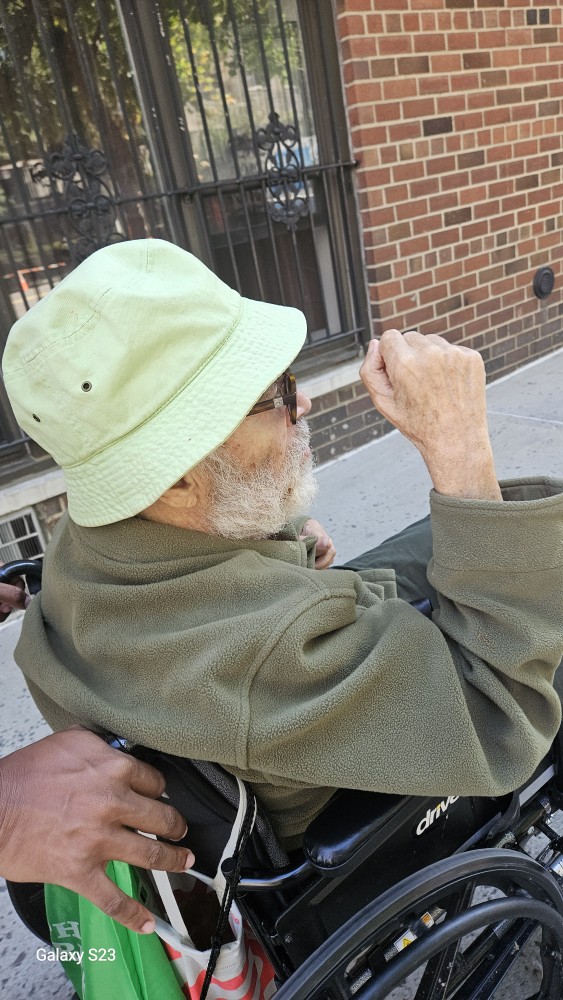
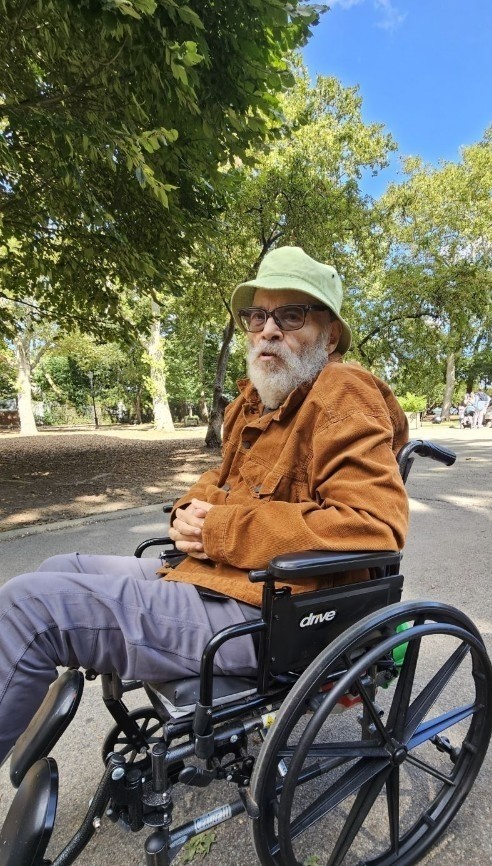
Still a puzzle. All week, he’s talking about loving it outside. It’s a gorgeous, warm, agreeable day, but Burt is not. Agreeable, that is.

We’ve discussed his fear that we won’t find our way home both  privately and with his “driver,” the weekend aide.

On this occasion, he recognizes that I am with him. So it’s not that he lost me. He just says he hates it. I put down my phone and use it only to take his picture. All my attention on him should help.

He does agree that if I am going out, he will too. Wonder what is going on in his emotional core. Oh well, at least we are outside.

Burt loves the heat, but perhaps it’s just the heat making him dull and making the pleasant less so.

Don’t get me wrong, we’re in the shade, and I give him plenty of liquids.

It’s all very serious to him, but I have to keep it in perspective.

One big thing

It’s a small thing that’s true, but just a few weeks ago, it was an all-consuming (pun intended) huge thing.

The food fight at the Beck house has subsided. That my friends is one BIG thing.

It’s not just that Burt’s asking for food, but he eats avocado and yogurt. Yogurt! I even gave him a spoonful of hummus.

And, some of this experiment is accompanied by disparaging words about what he’s eating. Yet he eats.

I feel like a weight has been lifted when he takes spoonfuls of trout and baby Brussels sprouts. He’s 84, it’s not going to be a very big meal.

I’m impressed by the variety and spurred to think about, to plan for more.

Dinner time is getting to be fun for us.

That’s a BIG deal. Bon appetit.

My poet

This is what I needed to move from the darkness I have been feeling. [To wit, a poem called Seeking Joy, which hardly hit its mark.]

It was a contribution by my love, my p.w.d.

Burt said something that was very uncharacteristic. He told me, “You’re talking to a poet.”

I said, “You are the poet of my soul.” My response was heartfelt and expressed my gratitude at his unusual utterance. Like his statement, it was uncharacteristic.

In the meantime, I had occasion to try to right my floundering ship of mood with another poem. It, too, was heartfelt but sprung from sadness.

Further support was a prompt in my caregiver writing group. This evoked sorrow but allowed me to fight through it. It offered a chance for me to buoy myself up.

The prompt was, “They’re looking good. The invisible burden.”

Here’s what I did with it. Note the reminder to look for the positives in care.

He’s doing well, they’ll say. No response to that makes it any easier. Yes, it’s a progressive illness, and we’re doing what we can. He has good days. I’m glad you got him on a better day. Your visit certainly perked him up.
In truth, I have rarely had to deal with that.

Burt’s pretty transparent, as it were, about his progression. I see more of the decline than others who aren’t with him all the time, but his confusion is evident. He’s not invisible; his disease is in the open.

He can be very clear about his demands, his needs, his wants. That can fool even me into believing he’s stronger than he really is.

Early on, his moments of clarity were a welcome opportunity to deny the realities of his illness. Denial is behind me now, and I face the truth of his decline minute to minute.

I need to say “he’s doing well” more often so I can appreciate what of him I still have.

Weighing the options

Let’s get practical about what is involved in care for your p.w.d.

I advocate getting an aide early on when perhaps all your dearest needs is companion care.

This is for you, the spouse or family caregiver. You definitely need the time while s/he is with someone.

The expenses are astronomical. I know not everyone can afford to follow my guidance. I couldn’t afford not to.

My time, aka me-time aka my own sanity-check, was an existential necessity. From day one.

Today, with Burt slipping ever more deeply down a slope of incomprehension [all right, it is I who has trouble understanding], it’s even more existential.

I need time to recharge, to see friends, have lunch, and exercise.

Even with my precious 5 hours a day, I am often frazzled. My short fuse needs the time apart to appreciate the good interactions.

Never mind the messy ones.

Time is not the only

A poem

So much has gone missing
As I mourn your losses and
The loss of you, the loss of
Your thoughts, recollections,
The loss of who you were or
How you form ideas, come
To conclusions. All the loss
That is clear, and all that is
Ambiguous, waiting in the
Wings for the big finale I am
Sure will tear my heart into
Many more pieces, break it
Again and again, as if you're
Being broken hasn't torn it
Apart. Time once was lost
Yet it still marks the losses.
All the time. Steadily. But oh
So slowly, and unpredictably.
So much has gone missing.
I miss you so much. All the
Time.

Poems of time and remembrance

He told me all his stories, so        
That when this day came, I’d
Be the one who remembered.


Love song: if I remember you


Is it lost if we mourn it


Mourning


When he lost the wisdom of his age


What feels like the loss


That he’s broken and breaking


[Like] Lear on the moor


You, my beloved, not only lose time/You misrepresent it


His time is lost and eludes him


Time, when you misplaced it


Only reminds me of how much time we have lost…


I remember memories, his, mine, ours


He is love and trouble


He has his too, uncertain


When time became a flight of fancy


They agreed to restore sorrow to the vocabulary of loss


The one about time losing its meaning


Ambiguous


Hold on

I’ve got you, fight me all you can
Fight me all you want and with
All your mighty might, and all
The will you can muster. Yours
Is a strong will, you show plenty
Of determination, so do I. I am
Determined. I won’t let go of you
I will not let you go. It’s not yet
Our time. That is our time is not
At an end. You and I will have this
Time as our own. I’ve got you now.
I am not ready. We are not ready.
Not now. I’ve got you now. Fight
Me all you want, but hold on tight.


What time is it?

When he stopped recognizing time
I had to know what time it was all
The time. Day and night for a while
Were his to mix and match but I had
To know what time it was all the time
Day and night. He would ask after it
Knowing that it was eluding him but
Wanting to keep track of the time all
The time. I had to know what time it
Was all the time to share the time
With him. I had to know if it was day
Or night, morning or evening for him.


In free fall

This is a horrid disease. I believe all dementias are damnable and heartbreaking.

Lewy, however, seems to offer behavioral twists and emotional wrenches that make it that much more accursed.

So, while all dementias are a burden on sufferer and carer, this is the one we’ve got.

Burt has quirks that predate his illness. He also has charms that still make him lovable. The two often overlap in strange and  unexpected patterns.

I am sure I mentioned his job quest elsewhere. It has morphed into an organized office venture in which his “new girl,” who is also a wife, has a place. I am #1 in  this project.

I worry that in listening to his plans, I acquiesce to lord knows what.

There is a lot of anxiety and fear mixed in with boredom in Burt’s life. [I’ve shared my anxiety over my passive participation in his schemes.]

For instance, he gets antsy when we’re out in the park. Since he demands to go out, this reaction was puzzling me.

It turns out that although we are talking and holding hands, he thinks I left him there. He doesn’t realize it’s me. It’s as if he’s in the midst of an inverse hallucination; he’s not recognizing me, though I am there.

He also worries his driver won’t get him home. And, of course, he doesn’t have control of the wheel chair as he does of his walker.

I often remind myself how hard it is being Burt.

Should’ve

When you came home from a walk and said you were lost on 5th Avenue, I was worried. When you told me you had experienced double vision, I worried again.

I should have asked you how you felt. Your worry was unspoken but deeply felt.

I should have said I’m worried, but you matter.

If this was the beginning [and I suspect it was], it was the missed moment. This was the time I should have shown you love and compassion.

I did, of course. I did, but it was silently shared. This was the moment to begin verbalizing feelings… expressing my support for you.

This was the moment to ask, “What do you need?” “How do you feel?

It would have helped. Well, no, it wouldn’t have changed anything. The disease still would have had its way, progressed. I would have lost you. You would have lost you.

I know you know I loved you. I think you knew. I think you know I felt your pain and fear. I think you know I empathised with your concerns.

I’m worried. But you matter.

Aggression

“So,” she asked, trying to put it tactfully. “Is Burt ever, how do I say it, does he lash out?”

Oh, yes, that famous Lewy Body aggressivity. 

It’s why an agency felt they had to deny services. Burt is, as I like to say, performatively belligerent. Of course, he is, but he does lash out.

It’s what I expected or at least was warned to expect.

I think the aggression comes with the fears.

It’s hard  to not be afraid when you are experiencing the weird that is inherent to dementia.

In the world according to Lewy, there are strange people in your home. You’re not actually sure you are home or will ever find it. Early your symptoms are just odd enough so you realize there is something very wrong. Later you may have delusions that make life untenable. Paranoia added to the mix makes it all sort of boil over.

Burt’s hallucinations are mostly benign. I think. His delusions can be very frightening.

Burt used to like it when I showed him his picture from our outings. Today, he said, “You’re not supposed to take my pictures in there. People will come after
me.”

The loss of a logical compass to determine if the scary is likely underlines everything in bold red.

The endless fears are fought off by  defensive aggression.

Do as I say…

Out of desperation over difficult mornings, I switched morning meds to early afternoon.

I had reservations about this choice but got the approval of his doctors.

At the time of my decision, Burt was fighting taking his pills in the a.m. and sleeping late. I needed to  get out of the house for my daily respite.

Since I instituted the “early to bed” routine, Burt is also up earlier.

I switched back, and within three days, he already seemed so much clearer.

Design a site like this with WordPress.com
Get started