What gives you direction in life?
My life changed the day I met him, and his love and care for me and the opportunity to care for him gave me direction these 35 years.

It has been a lovely journey, bumps and all.

Several children were delighted by my wearing my Bluey t-shirt today. There was also one father, a friend who had a picture of his tyke with the characters on his phone, who was pleased by my choice of attire. We agreed that Bluey was the best father.
When I first discovered the iconic cartoon I decided it was perfect fare for Burt and me. Nice color, quiet talk, a gentle vibe made it attractive.
I persisted with it even as Burt was likely beginning to bore. It was an example of my pushing the agenda. Just a little.


Years ago, I told a diner next to me, I was a member at Cooper – Hewitt. I dragged my husband to the parties they threw here on the grounds.
He nodded and said “Janet drags me.” We agreed that he liked it. I said I dragged the poor fellow to the Merchant’s House on E. 4th Street, too. There was food, so he was alright. I was remembering what a good time Burt and I had at both events. The garden party at the Cooper-Hewitt was some 35 years ago.
The night was warm and we had a lovely evening. The well-kept lawn was green, as it was this afternoon. There were beautiful decorations in red and blue.
Today, on this afternoon, the crowd was there sampling foods prepared from produce grown at an indigenous farm. In some way, I had dragged Burt here with me as well.
The Museum produced Making Home, a program dedicated to looking at the meaning of home.
The Tohono O’odham Nation’s Alexander Pancho Farm in Sells, Arizona contributed a display of a desert building; they offered to enlight and educate us on the role of agriculture in their heritage. The desert construction is displayed in a gallery upstairs. The uses of seasonal plants as food were the contents of a party in the garden.
I was there to learn about Native food traditions and history from farmer Noland Johnson, Amy Juan, and Mary Paganelli Votto.
Michael [Mikey] Enis of the Tohono O’odham Nation sang an invocation.

Displays of flour crushed from the flowers of mesquite trees and syrups extracted from the cactus drew lots of questions. They were expertly answered.
We were served delicious foods made from recipes using the traditional ingredients from the farm.
There was a rich bean soup with oxtail and a salad from grains, dessert sweetened with saguaro cactus.
It was warm and the light rain did not daunt. This was a lovely day. One of the presenters honored me by taking a selfie with me; “I like your personality,” he told me.


Your mind on grief is suffering from trauma.
Any caregiver with a loved one captured by dementia knows grief from diagnosis on. In my case, I was grieving for the past 5+ years.
One morning shortly after Burt’s passing, I awoke to a my I have been under strain moment. Some awakening. It comes with a duh.
Healing requires getting the brain and body back to functioning. Lots of this is fundamental, part of how we are hardwired. It’s also likely slow. More duhs.
This video explains it simply and directly. And will require more viewings.
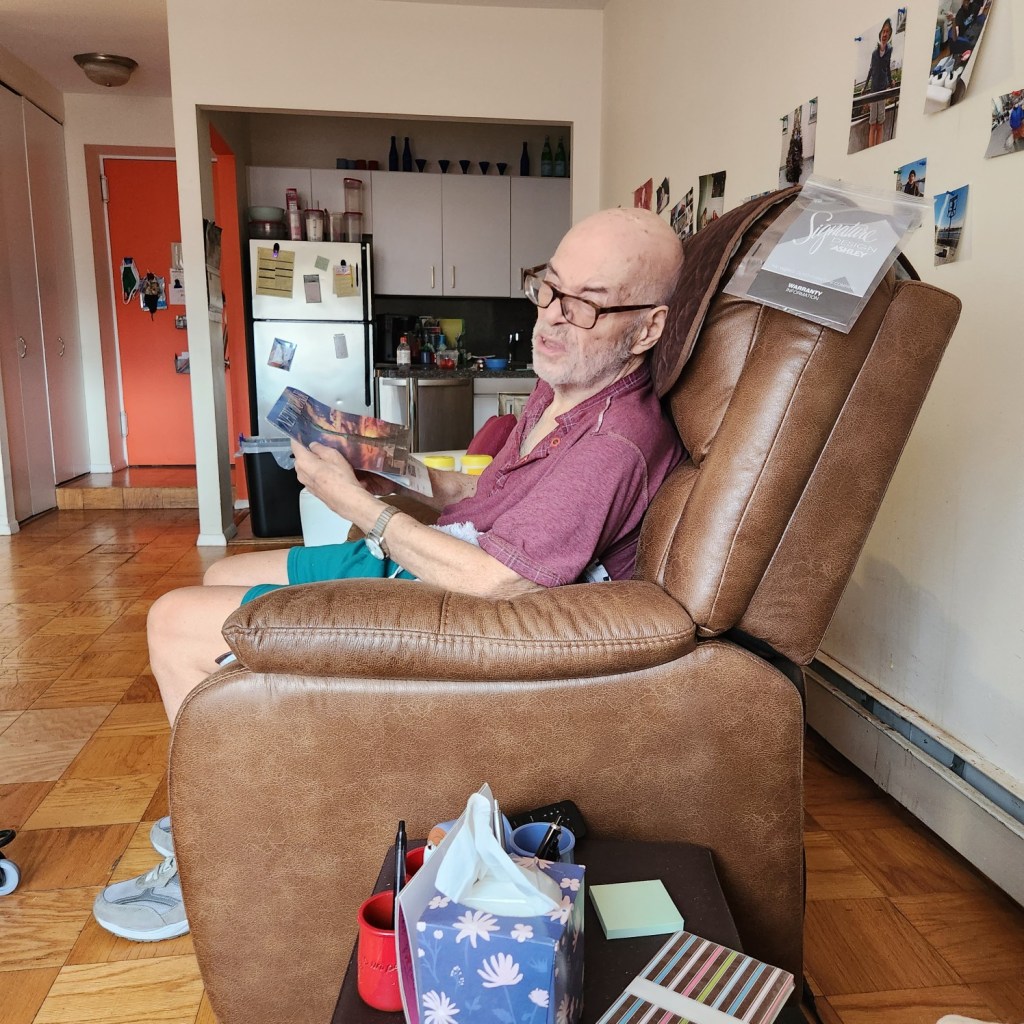
As I enjoyed the fantastic Max Pollak Group tap, I had the memory of Burt tapping along as we watched a dancer on tv. He was seated in his big brown chair. His feet were dancing along.

Burt loved tap dancing.
He would have loved this show. In some ways, he was there enjoying with me.
Keeping busy helps me work through my grief. It also takes me away from the business of my grieving.
Grief need not be avoided and often the busy-ness of my days skirts the pain of my grieving.
While Burt was ailing busy was intricate to mourning. There was a relentless gradual loss.
Now, busy is good. It keeps me moving forward, of course, while reminding me of happy times past. The past from before the debilitations of dementia.
In truth, activity does not displace my loss. It may distract, but more often with it come a flood of my remembrances of Burt.
I welcome those since as they come up, they are generally of our good old days. And we had many of those.

Looking back, the blur of our journey as we trudged, loped and galloped along is confusing.
Is it surprising that an illness characterized by confusion would cause confusion? Create it for the travelers as they travailed its inconsistencies? The one who is well as much as the afflicted?
Burt’s confusion was a natural by-product of the Lewy Body Dementia from which he suffered. Mine was the fog of care and the overwhelm of events and information.
We all know how this ends, I opined in a support group. It does not end well. Heck, friends, its start isn’t propitious either. There is enough grief to stretch and stay the course.
My mission today was to parse if the end was quick or slow. It was both expected and a complete surprise. So, I guess it’s not a fudge to claim it was both slow and quick.
As it turns out, my retrospective on this excursion takes me back to a mere four months prior to Burt’s passing. In late October, he wasn’t participating as he had and hallucinating more.
For his surprise birthday party, he was more out of it than in. He didn’t take pleasure in seeing people as he used to. Our outing on November 10th was the last one we would manage.
He got up to sit in his big brown chair for his friend M’s visit a few days later. It was an effort and he asked to return to his bed. We talked by his side but it was pretty clear that Burt wasn’t sure who we were. After that, he.was mostly bedbound.
He tried to get up for a trip to get pistachio ice cream, but could not. Even I, reluctant to catch the decline, saw it and offered to bring him some.
I had every hope that, this being Lewy, Burt would ride the roller coaster up and go back to better days.
In mid December, I went to sign a Molst for end of life decisions. His doctor and I agreed to proceed as if he were on palliative care.
Burt seemed comfortable. Bed care has some issues of its own, like pressure sores, that we addressed. I held onto my hope that Burt would get out of bed to go for a walk; it was slimmer but still active.
These were the days when Burt held more conversations with his imaginaries. He would often interrupt me, ever so politely, to see what they had to say.
Then came what I have dubbed the last four days. On Friday, he stopped grabbing and holding our hands. His grip was so strong! before that. His hands were reaching and he wasn’t speaking. Just gesturing in the way of a supplicant. I knew.
Someone had introduced me to the term actively dying. I knew that that was what this was. Burt was actively dying.
The fact that it took him four days to find his exit is both a long and a short time. I am relieved that he found his way. I am sad to have lost him. I no longer travel his journey with him. Burt is no longer by my side as I continue mine.